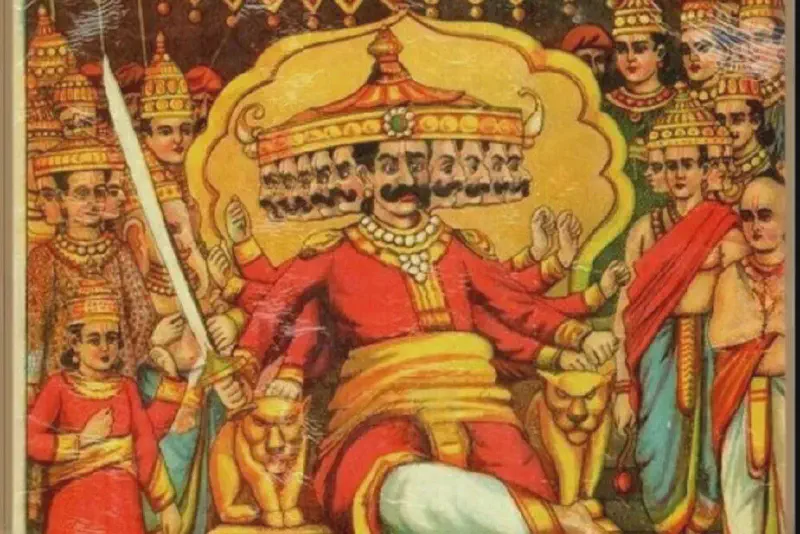
Ravana, the mighty ruler of Lanka, was no ordinary king. In the epic traditions of India he is portrayed as a paradoxical figure, at once a terrifying antagonist and a man of immense learning and accomplishment. He was a great warrior, a master of the Vedas and scriptures, a skilled musician who composed several hymns, and a ruler whose kingdom of Lanka was famed for its wealth and grandeur.
His queen Mandodari, celebrated in the epics as wise and virtuous, became pregnant with their first child. Ravana believed that this son would carry forward his glory and perhaps even surpass him. Determined to ensure that the child would be invincible, he turned to the science he knew well: Jyotisha, the ancient Indian system of astrology.
Ravana’s Astrological Ambition
According to later Puranic traditions, Ravana himself was a great astrologer and scholar of the cosmic sciences. Ancient texts describe him as the author of the astrological treatise Ravana Samhita, a work still circulated in some traditions of Jyotisha.
When Mandodari’s time of delivery approached, Ravana calculated the celestial alignments. In astrology, the position of the Navagrahas (the nine planetary influences) at the time of birth is believed to shape destiny. Ravana wanted the most powerful configuration possible.
In particular, he wanted all the planets aligned favorably in the eleventh house, which in astrology signifies victory, success, power, and fulfillment of ambitions. If achieved, Ravana believed his son would be invincible and virtually immortal.
In a dramatic display of cosmic arrogance, Ravana is said to have captured the Navagrahas themselves.
According to the legend, Ravana placed the nine planets face-down beneath the steps of his palace staircase, forcing them to lie prostrate on their backs while he walked over them. By doing this he believed he could prevent the planets from moving into inauspicious positions and hold them fixed until the moment of his son’s birth.
The planets included:
- Surya (Sun)
- Chandra (Moon)
- Mangala (Mars)
- Budha (Mercury)
- Brihaspati (Jupiter)
- Shukra (Venus)
- Shani (Saturn)
- Rahu
- Ketu
All of them were forced to remain obedient—except one.
Shani, the slow and relentless lord of karma, is feared in astrology because his gaze is believed to bring trials, hardships, and karmic justice. In the story, Shani refused to submit completely.
Despite Ravana’s command, Shani slightly tilted his gaze or shifted position, allowing his influence to fall upon the horoscope of Ravana’s son.
Because of this subtle defiance, Ravana’s plan for complete invincibility failed. The child, though immensely powerful, would not be immortal.
The boy was named Meghanada, meaning “the roar of the clouds,” because thunder rolled across the sky when he was born. Later he would earn the name Indrajit, “the conqueror of Indra,” after defeating the king of the gods in battle.
Narada’s Mischief
The celestial sage Narada, known for both wisdom and playful mischief, eventually visited Lanka.
Seeing the planets trapped beneath Ravana’s staircase, Narada praised the king’s power but suggested that true dominance required placing the planets face-up, so that Ravana could step on their chests rather than their backs.
Flattered by Narada’s words, Ravana ordered the planets turned over.
The moment this happened, Shani’s full gaze fell upon Ravana, initiating what astrologers would call the beginning of Ravana’s Shani Dasha—a period of karmic reckoning that would ultimately lead to the destruction of Lanka.
Furious at being outwitted, Ravana seized Shani again and imprisoned him in a dark chamber, binding him face-down so that his gaze could harm no one.
Hanuman and the Liberation of Shani
Years later, during the events of the Ramayana, Hanuman entered Lanka in search of Sita, the abducted wife of Rama.
While exploring the city, Hanuman heard cries from a dark cell. Inside he found the imprisoned Shani.
Hanuman broke open the prison and freed the planet-god.
However, Shani explained that he was bound by cosmic law: whenever he sat upon someone’s head, that person would experience Sade Sati, a period of seven and a half years of intense karmic trials.
Shani therefore sat upon Hanuman’s head.
But Hanuman was no ordinary being. His mind was completely absorbed in devotion to Rama.
When he felt an itching sensation on his head, Hanuman simply smiled.
Growing to his gigantic form, he lifted great mountains and placed them upon his head while scratching it, crushing Shani beneath their weight.
Shani, overwhelmed, pleaded for mercy.
Hanuman finally released him.
Grateful and humbled, Shani promised that those who worship Hanuman with devotion would receive protection from the harsh effects of Saturn’s influence.
This belief explains why Hanuman worship is traditionally recommended in astrology to reduce Shani dosha.
🙏 Namaste